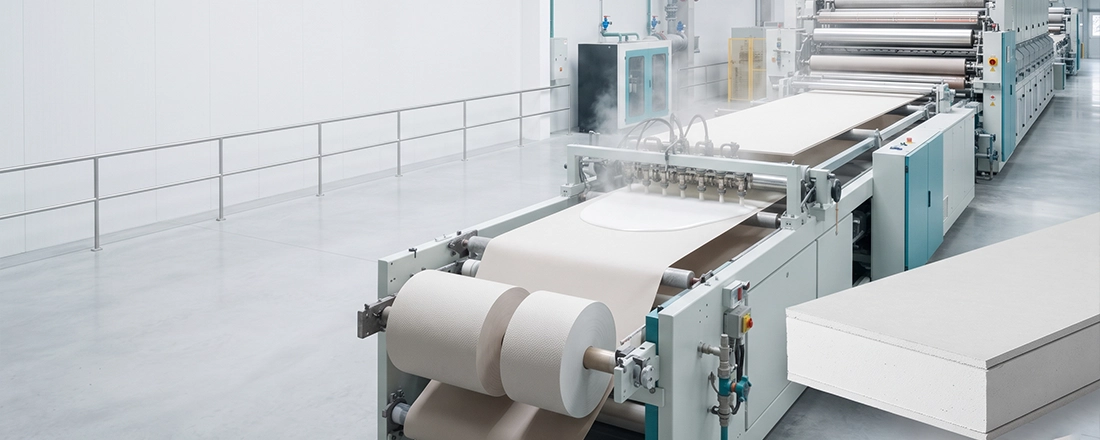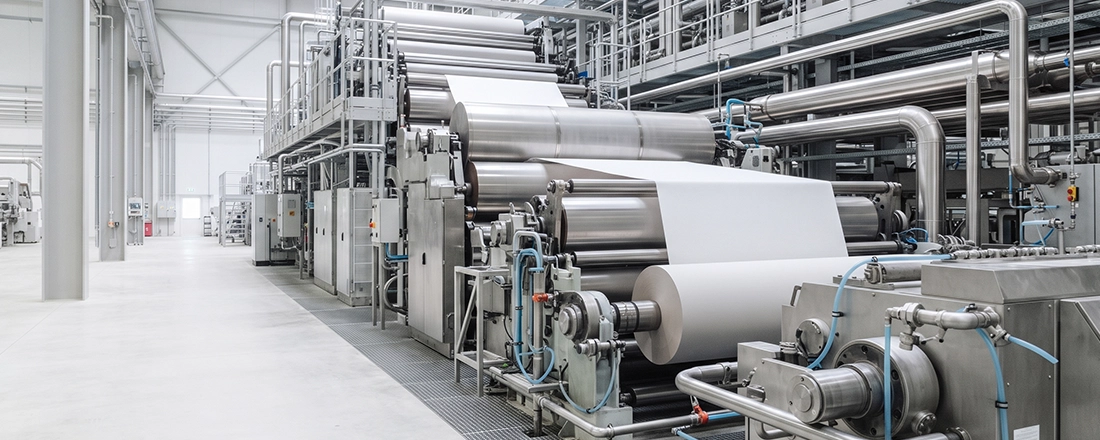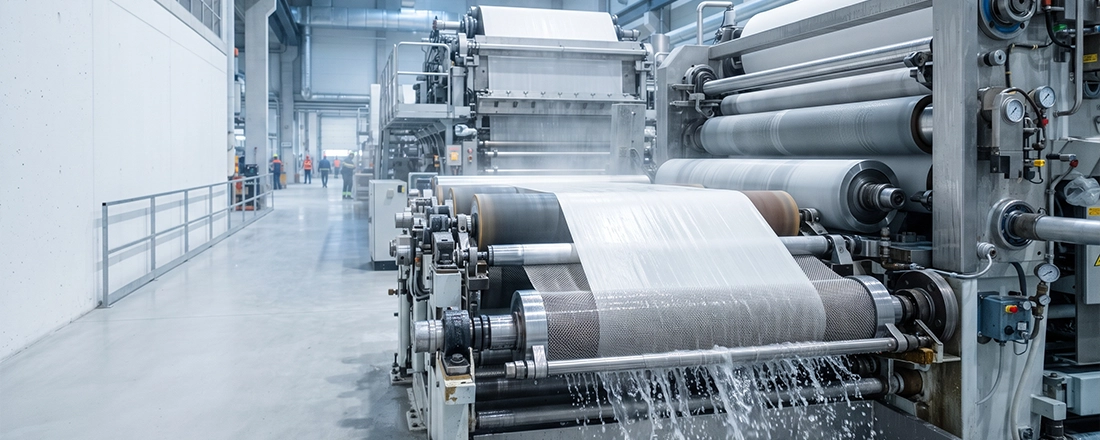
A paper machine can be hundreds of metres long, yet some of its biggest efficiency gains are decided within the first moments of sheet formation.
At the wet end, fibres, fines, fillers, water, and additives come together in a highly dynamic environment. The challenge is simple to describe but difficult to perfect: keep valuable solids in the sheet while efficiently removing water. Lose too many fines and fillers, and material efficiency suffers. Remove water too slowly, and the machine has more work to do downstream.
This is where retention and drainage aids play an important role in the chemistry of papermaking. These systems are linked with improved sheet quality, productivity, and machine performance when appropriately selected and applied.
What Do Retention and Drainage Aids Actually Do?
Retention and drainage are closely related, but they solve different problems.
Paper machine retention chemicals help fine fibres, mineral fillers and other small particles remain within the developing sheet rather than passing through the forming fabric with the white water. Common systems use polymers such as cationic polyacrylamide (C-PAM), which can promote flocculation by connecting negatively charged fibres and inorganic filler particles.
Drainage aids, meanwhile, help water separate more effectively from the fibre suspension during sheet formation. Some chemical programmes are designed to improve both processes simultaneously, which is why retention and drainage are often considered together.
Better Retention Means Better Use of the Furnish
Modern paper furnish can contain significant amounts of fines and mineral fillers such as calcium carbonate. Because these particles are much smaller than the main fibres, they can readily escape through the forming fabric.
A properly optimised retention aid in the paper industry encourages these smaller particles to associate with the fibre network. This means more of the material entering the process can become part of the finished sheet rather than continuously circulating in the white-water system. Research on C-PAM, for example, shows that characteristics such as molecular weight, charge density, and branching influence filler retention and drainage performance.
Why Drainage Has a Bigger Job Than It Seems
Paper starts as an overwhelmingly water-based suspension. Much of that water must be removed before the sheet reaches the dryer section.
Effective drainage aids in papermaking promote dewatering at an earlier stage. Retention and dewatering aids can form flocs with better drainability, creating the potential to support higher paper-machine speeds. Efficient dewatering is an important opportunity for improving energy efficiency in papermaking.
The principle is straightforward: water removed efficiently at the wet end is water that does not have to travel unnecessarily through later stages of the process.
The Goal Isn’t Singular. It’s Balance.
Here is where wet-end chemistry becomes more interesting.
If flocs become excessively large, they can negatively affect sheet formation, paper strength, and even dewatering. Simply adding more retention chemistry does not necessarily improve performance.
The real objective is to find the right balance between retention, drainage, and formation. This is why paper-forming chemicals must be considered part of a wider wet-end system rather than isolated additives.
Why the Right Retention Programme Matters
Retention programmes are not one-size-fits-all. Their performance can vary with the furnish, filler characteristics, and chemistry being used, meaning the same approach may not deliver the same results under different papermaking conditions. Selecting and optimising a suitable retention system is therefore important for balancing retention, dewatering, and sheet formation.
Conclusion
Paper machine efficiency is not determined by speed alone. It depends on how effectively fibres, fillers, water, and chemistry are managed from the very beginning of the process.
The right retention and drainage aids help mills strike a critical balance, retaining valuable solids, improving dewatering, and maintaining good sheet formation. When these factors work together, they create a more stable foundation for consistent quality and efficient production.
Ultimately, effective retention and drainage are not about maximising one parameter. It is about optimising the wet end as a complete system.