Introduction: Where Paper Efficiency Really Begins
A modern paper machine operates at remarkable speed. Within seconds, a watery fibre mixture becomes a continuous sheet of paper. The invisible yet crucial wet-end chemistry enables this rapid transformation.
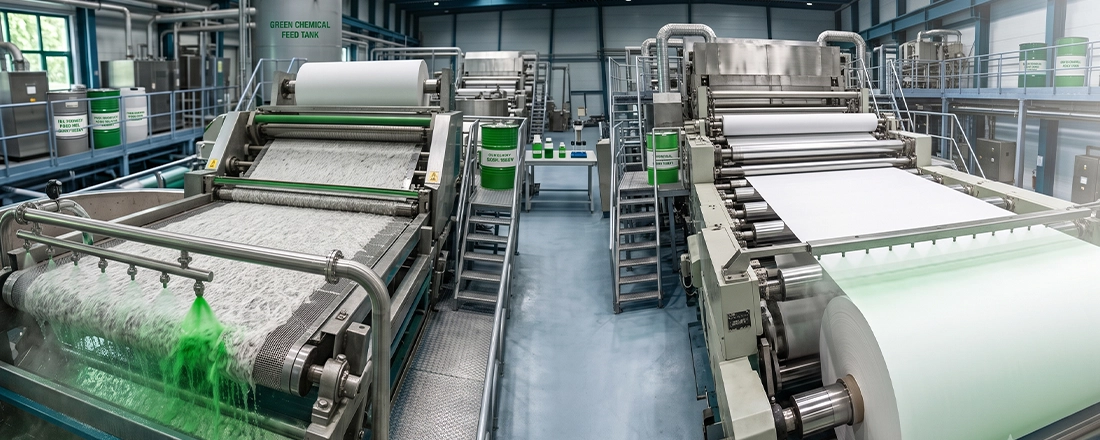
At the initial stage of papermaking, the pulp slurry primarily consists of water. The process challenge is to maximise retention of functional fibres and mineral fillers in the paper web while promoting efficient dewatering to sustain optimal paper machine efficiency.
Without the right chemistry, raw materials wash away with the water, drainage slows, and paper quality suffers. Retention aids in papermaking and paper drainage chemicals address these issues, helping mills keep valuable materials, speed water removal, and ensure stable production.
The Wet-End Challenge in Papermaking
In the early wet end of papermaking, fibres, fillers, and additives are suspended in water. As this mix spreads through the forming section, water must drain quickly while fibres bond to form a sheet.
However, several operational challenges can occur:
• Colloidal fines and fillers may be lost in white water
• Drainage can become suboptimal
• Sheet structure may become heterogeneous
Retention and drainage systems are designed to solve these issues simultaneously, and this is where wet-end chemistry becomes the defining factor in overall paper machine efficiency.
What Retention Aids Do
Retention aids in papermaking are water-soluble polymer additives used to improve the retention of fibres, fillers, and fine particles within the paper sheet.
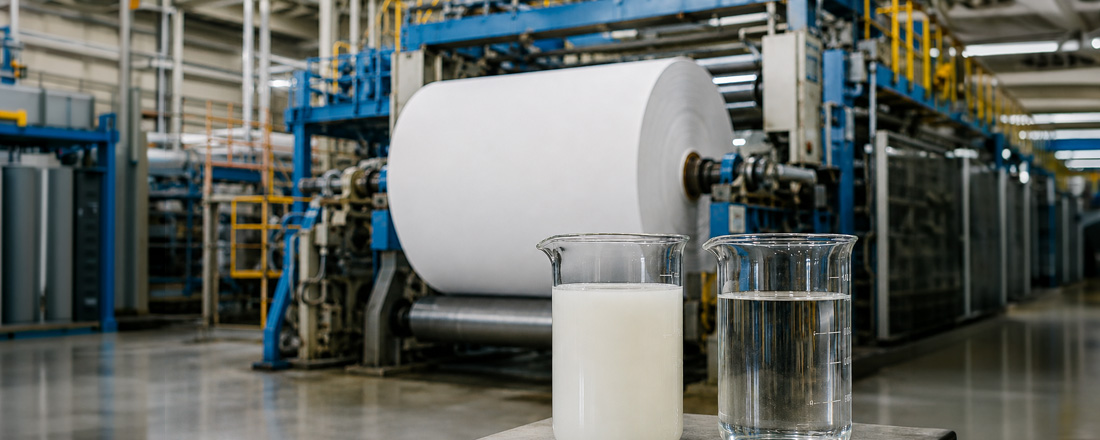
In papermaking, materials such as calcium carbonate, clay fillers, and fibre fines are extremely small. Without chemical support, they easily escape through the forming wire along with the water.
Retention aids solve this problem by helping these particles bond to the fibre network. The result is stronger particle capture within the sheet.
This results in several important benefits:
• Higher first-pass retention of fibres and fillers
• Improved paper strength and uniformity
• Reduced raw material losses
• Cleaner process water
The Role of Paper Drainage Chemicals
While retention keeps materials in the sheet, paper drainage chemicals focus on efficiently removing water.
Water removal is one of the most important factors affecting paper machine efficiency. If drainage is slow, the machine must run at lower speeds to prevent sheet instability.
Paper drainage chemicals help address this by improving water flow through the forming fibre mat. They encourage fibre structures that allow water to escape more easily while maintaining sheet integrity.
Better drainage leads to several benefits:
• Faster machine speeds
• Improved pressing and drying efficiency
• Reduced energy consumption
• More stable production runs
Why These Chemicals Matter Even More Today
The paper industry has evolved significantly in recent years. Several trends have made wet-end chemistry more complex:
Higher recycled fibre usage
Recycled pulp often contains more fines and contaminants, which affect retention and drainage behaviour — placing greater demands on retention aids in papermaking.
Faster paper machines
High-speed machines leave less time for particle settling, making precise chemical control essential for maintaining paper machine efficiency.
Closed water systems
Modern mills recycle more process water, which increases dissolved substances that can interfere with papermaking chemistry.
Process Efficiency and Sustainability Benefits
Beyond improving production performance, retention aids in papermaking and paper drainage chemicals also support sustainability goals in paper manufacturing.
Better retention means:
• Less fibre and filler loss
• Lower chemical consumption
• Reduced wastewater load
Improved drainage means less water must be evaporated later during drying. Since drying is one of the most energy-intensive stages in papermaking, this can significantly reduce energy consumption — a direct improvement to paper machine efficiency and environmental performance.
In this way, effective wet-end chemistry supports both operational efficiency and environmental responsibility.
Achieving the Right Chemical Balance
Retention and drainage chemistry must be carefully balanced. Too much flocculation can affect sheet formation, while too little can lead to material loss and poor drainage.
Modern papermaking, therefore, relies on integrated retention systems that combine polymers, microparticles, and charge-control strategies. These systems are tailored to each machine, fibre mix, and product grade.
When optimised correctly, they create the ideal balance between retention, drainage, and formation — three elements that define paper quality and overall paper machine efficiency.
Conclusion
In modern papermaking, performance begins long before the sheet reaches the dryer. It starts in the wet end, where the right wet-end chemistry determines how efficiently fibres stay in place and how quickly water can leave the system.
Retention aids in papermaking ensure valuable materials remain in the sheet, while paper drainage chemicals keep production moving smoothly. Together, they help mills achieve higher efficiency, consistent quality, and more sustainable operations.
As machines run faster and fibre sources become more complex, mastering this balance will continue to shape the future of efficient paper manufacturing.
Frequently Asked Questions (FAQ)
What are retention aids in papermaking and how do they work?
Retention aids in papermaking are water-soluble polymer additives that help keep fine fibres, fillers, and mineral particles within the paper sheet rather than washing out through the forming wire. They work by promoting flocculation — causing small particles to aggregate and bond to the fibre network. The result is higher first-pass retention, improved sheet uniformity, and reduced raw material losses.
What do paper drainage chemicals do?
Paper drainage chemicals improve the rate at which water is removed from the pulp slurry as it passes through the forming section of the paper machine. By encouraging fibre structures that allow water to drain more freely, they help mills run at higher machine speeds, reduce energy use in drying, and maintain consistent sheet quality.
Why is wet-end chemistry important in modern papermaking?
Wet-end chemistry governs what happens in the earliest, most critical stage of paper formation. It controls how well fibres and fillers are retained, how efficiently water drains, and how uniform the sheet structure becomes. As mills increasingly use recycled fibres, faster machines, and closed water systems, optimising wet-end chemistry has become more complex — and more important — than ever.
How do retention and drainage chemicals affect paper machine efficiency?
These chemicals directly impact paper machine efficiency in several ways. Better retention reduces material losses and raw material consumption. Improved drainage allows machines to run faster without sheet instability. Together, they reduce downtime, improve energy efficiency in the drying section, and support more stable, consistent production runs — all of which lower operating costs.
How do these chemicals support sustainability in paper manufacturing?
When retention aids and paper drainage chemicals are optimised, less fibre and filler escapes into the white water, reducing both raw material waste and wastewater load. Better drainage also reduces how much energy is needed in the drying section, since less water needs to be evaporated. Together, these improvements help mills reduce their environmental footprint while maintaining production performance.
How does Ivax support retention and drainage optimisation?
Ivax provides specialised wet-end chemistry solutions designed to help mills optimise retention aids in papermaking and paper drainage chemicals across a range of fibre types, machine speeds, and product grades. By tailoring integrated retention systems to each mill’s specific conditions, Ivax helps improve paper machine efficiency, product consistency, and sustainability performance.