Introduction
Every day, paper products are expected to carry weight, such as print weight, packaging weight, or just the weight of everyday use. But when a sheet tears too easily, curls, or falls apart after getting damp, the result is frustration, waste, and cost. So, what gives some papers the ability to withstand intense handling, humidity, or heavier loads? The answer lies in the world of chemical additives for paper making. The transformative agents that can change ordinary pulp into a strong, reliable sheet. Let’s explore how manufacturers make paper tougher, the role of specialised chemistry like wet strength resin, and practical ways of how to increase paper strength to meet today’s demands.
Understanding the Need for Strength and Durability
Paper consists of cellulose fibres joined by hydrogen bonds and by mechanical pressing. However, in conditions of stress, such as moisture, vibration, or even continuous folding, the fibre-bond network can fail. That’s why durability matters. In packaging, tissue and towel, labels, and speciality papers, strength isn’t just a nice-to-have, but a must. When you ask, “how to increase paper strength”, you’re really asking how to improve fibre bonding, chemical adhesion, and sheet formation so the end-product can stand up to real-world use.
How Chemical Additives for Paper Making Work
Dry strength vs wet strength
There are two broad categories of strength improvement: dry strength and wet strength. Dry strength additives enhance performance under normal (dry) conditions, improving tensile, burst and tear resistance. For instance, cationic starch or polyacrylamide is commonly used.
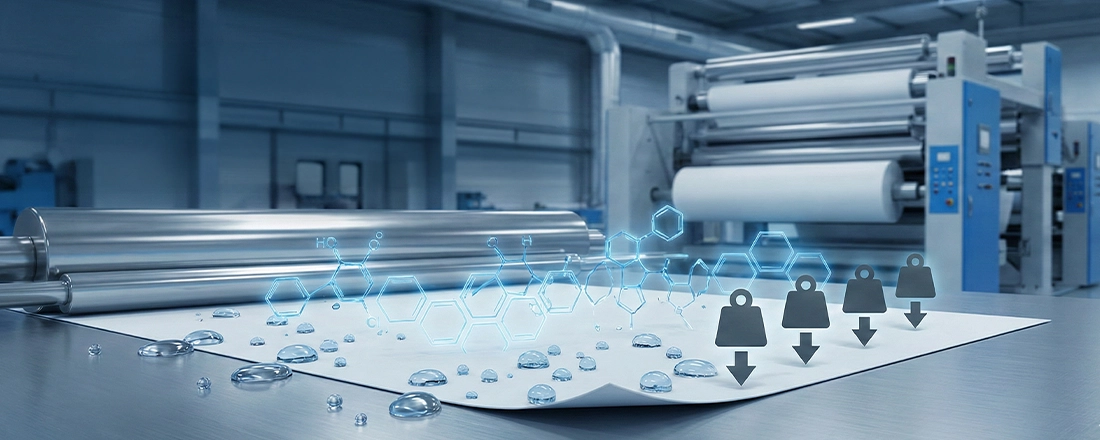
In contrast, for demanding conditions, products exposed to moisture or humidity, you’ll rely on a wet strength resin. These resins create cross-linking between cellulose fibres, which survive when water attacks the normal hydrogen bonds.
Mechanism in brief
Upon addition of a wet strength resin, covalent bonds or strong chemical links are formed between the cellulose network and the added resin. Instead of the typical hydrogen bonds, which break down under wet conditions, these stronger bonds hold the structure together. The result: paper that retains strength when wet, in humid environments, or in heavy‐duty use.
Practical Ways of How to Increase Paper Strength
Here are key strategies mills use when implementing chemical additives for paper making:
- Optimised dosage and placement: Strength agents must be added at the right stage, wet end vs size press, and at an accurate concentration. Too little gives little improvement, and too much can hamper recyclability or cost more.
- Balance fillers: While high filler loads reduce cost, the sheet weakens unless compensated with strength additives. The right chemistry ensures that increasing filler doesn’t mean sacrificing strength.
- Quality of fibre bonding: Additives which favour the adhesion of fibres between them, by improving contact and bonding, directly improve tensile strength and tear resistance.
- Moisture resistance: With products that are exposed to liquids or high humidity, for example, food packaging, wet wipes, and tissue, a strong wet-strength resin application ensures the sheet maintains integrity and performance.
Process control and synergy: Strength improvement will not take place with just a single product. Additives need to interact with retention aids, drainage aids, and sizing agents. A holistic approach makes sure that the chemicals interact without adverse side effects such as poor formation or stickies.
Key Benefits of Strength-Focused Additives
When done well, the benefits of using chemical additives within paper making are tangible:
- Better product performance: Tough sheets resist tearing, withstand stress, and function when wet—a key advantage in many markets.
- Cost savings and material efficiency: A stronger sheet can allow for lower grammage or higher filler content without sacrificing quality, thus reducing raw material cost and weight.
- Better machine runnability: Sheets of more consistent strength and formation run smoother, produce fewer breaks, and reduce waste.
- Sustainability gains: Stronger fibres mean less waste, better yield, and possibly better reuse or recycling. But this must be balanced, especially with wet strength that may affect recyclability.
Challenges and Considerations
Of course, implementing strength additives isn’t without trade-offs:
- Recyclability concerns: Some wet strength resins form permanent bonds that make fibre recovery harder. So, manufacturers must make careful choices about chemistries if recycled content or fibre reuse is an objective.
- Cost and dosage optimisation: Many of the high-performance additives are more expensive per tonne, so optimisation of dosage and selection is very important to ensure ROI.
- Compatibility and runnability: Adding one agent may interfere with drainage, retention or coating performance. Synergies across chemistries need to be monitored.
- Regulatory and safety issues: Health and environmental reasons have led to the phasing out of older resins, like those based on formaldehyde.
Conclusion
In today’s demanding world of paper production, strength and durability aren’t just features; they’re engineered outcomes. The result of employing well-targeted chemical additives for paper making, including advanced wet strength resin systems, is that manufacturers can dramatically improve the integrity, wet condition performance, and overall reliability of the sheet. If you ask how to increase paper strength, then your answer will be controlled fibre bonding, smart additive design, and seamless process integration.
Equipped with the knowledge of formulating strength-enhancing systems for performance aligned with precision, Ivax can offer solutions targeted at specific needs.
Learn more about our strength-enhancing formulations.
https://ivaxchem.com/