Introduction
Imagine turning a block of wood into a thin, printable sheet that can carry words, wrap goods, or absorb moisture. That transformation is nothing short of alchemy, and it’s the heart of how the process of paper making works. In this post, we’ll peel back the layers of the industrial paper-making process, showing not just how it happens, but how mills make sure each sheet is right.
What Is Papermaking?
Papermaking is the method by which fibrous material, most commonly wood pulp or recycled fibre, is converted into sheets of paper. In the industrial paper making process, raw materials go through mechanical and chemical steps. Cells are separated, water is removed, surfaces are treated, and finishing touches are applied so the paper behaves just as intended. It is described as forming a matted or felted sheet of cellulose fibres from a water suspension onto a wire screen.
This definition sets the stage for the steps to follow, from pulp to roll.
Step-by-step process of paper making
1) Raw materials to pulp
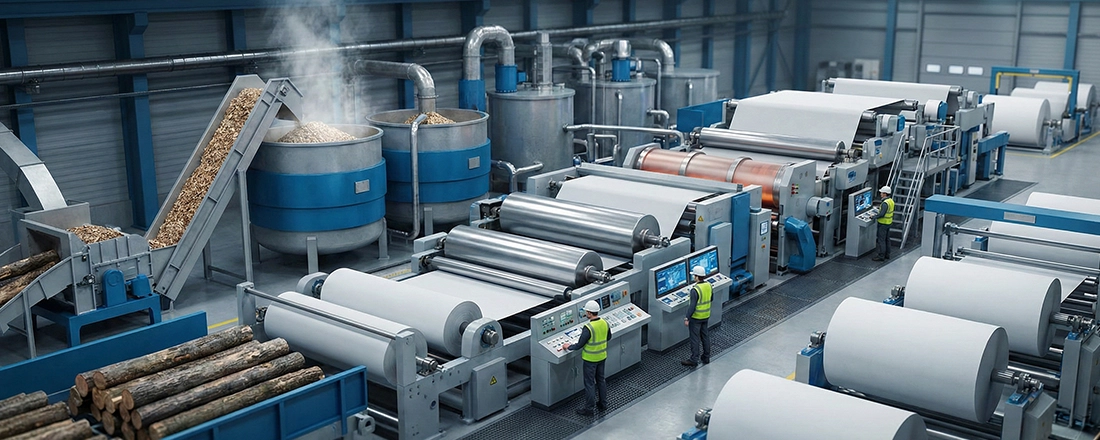
Logs are debarked and chipped, and recycled paper is repulped. To free cellulose from lignin (wood’s natural “glue”), mills either grind chips mechanically (higher yield, lower strength/brightness) or cook them chemically (kraft: sodium hydroxide + sodium sulphide) to dissolve lignin and produce stronger, cleaner fibres. This is the first quality gate of the industrial paper-making process.
2) Cleaning, screening & refining
Fresh pulp is washed and screened to remove grit and knots, then refined (beaten) so fibre surfaces “fibrillate,” opening bonding sites. Refining is a critical tuning step. It drives formation, tensile strength, and surface feel long before you ever see a sheet.
3) Chemistry that builds performance
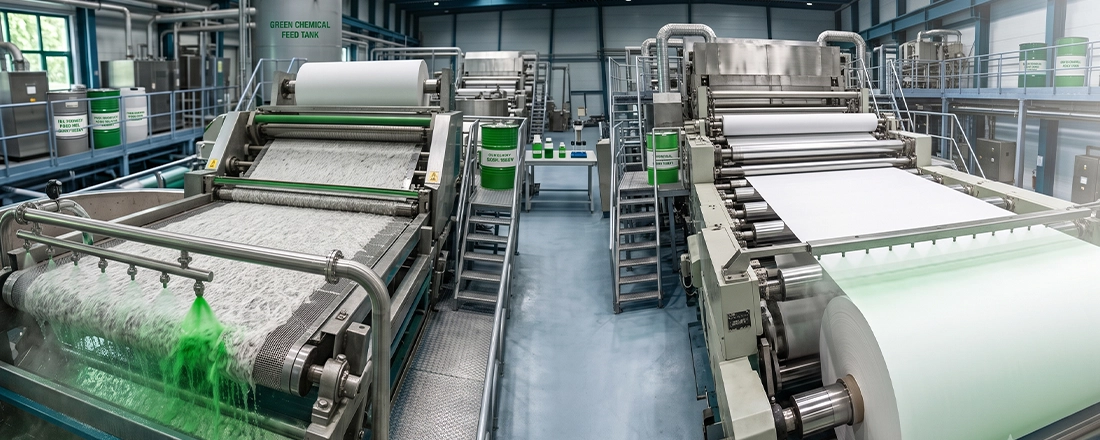
Before sheet formation, mills blend targeted paper chemicals into the stock, such as sizing agents (water/ink control), fillers like calcium carbonate or kaolin (brightness, opacity), dry/wet-strength resins (durability), and retention/drainage aids (keep fine particles and additives in the web). The choices here hard-wire printability, runnability, and cost into the sheet.
4) Sheet formation (the wet end)
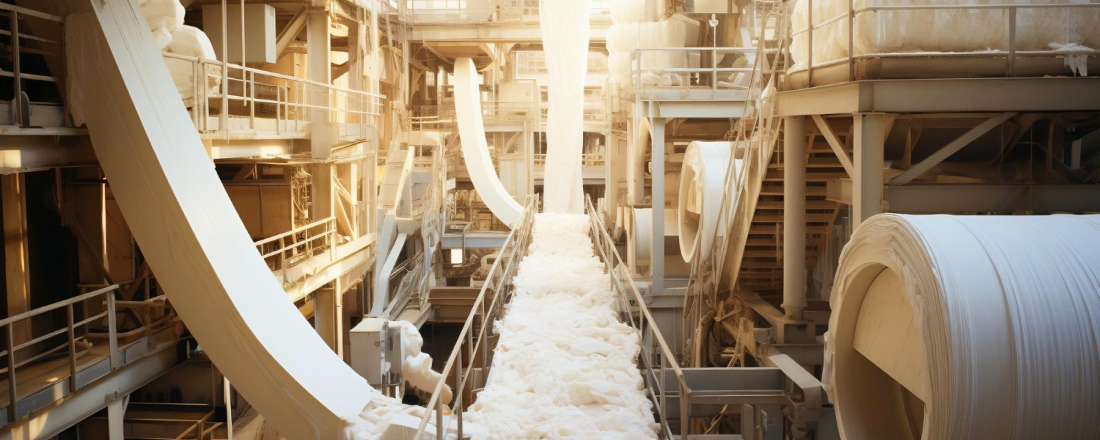
Diluted to ~1% fibre, stock jets from the headbox onto a moving wire (Fourdrinier). Gravity, foils, and suction boxes remove water while fibres interlock into a continuous wet web. Formation uniformity at this moment sets the ceiling for later strength, smoothness, and visual consistency. Once formation goes wrong, you can’t “polish” it out downstream.
5) Pressing
The fragile web enters one or more press nips with felt support. High pressure squeezes out water, compacts the sheet, and boosts fibre-to-fibre bonding, reducing the thermal load you’ll need in drying. Press felt design and loading are tailored to grade and speed.
6) Drying to final moisture
The web snakes across banks of steam-heated cylinders until moisture stabilises (typically ~4–7%). Drying is energy-intensive and must be uniform. Uneven profiles lead to curl, cockle, or internal stresses that show up in printing and converting. Modern mills focus on heat recovery and efficiency here.
7) Finishing & coating
Depending on the grade, paper is calendered (polished rolls) for smoothness and thickness control and may be surface-sized or coated (pigments + binders) for gloss, ink holdout and colour fidelity, and the “feel” customers recognise. Calender and coating can be online or offline, depending on the flexibility needed.
8) Conversion, packaging & internal recycling
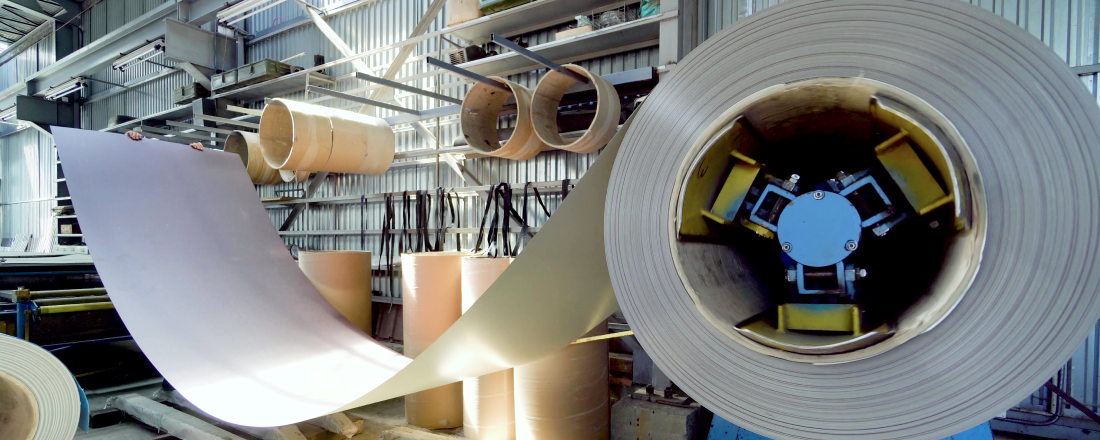
Reels are slit, sheeted, or rewound to order, inspect, wrap, and ship. Trims and off-spec broke are repulped. Mills increasingly recover water and energy, pushing toward closed-loop operation to cut footprint and cost.
How to ensure quality
- Incoming fibre control – Verify fibre mix, contaminants, freeness, and brightness before stock hits the machine, so variability is addressed upstream rather than on-machine.
- Real-time machine monitoring – Use sensors and feedback loops to track basis weight, moisture profile, formation, chemical dosage, and drainage; correct deviations on the fly to stabilise the web.
- Laboratory validation – Pull routine samples for tensile/tear, calliper, opacity/brightness, and surface smoothness to confirm property targets before release.
- Final inspection & internal recycle – Inspect reels for shade variation, pinholes, edge cracks, and gloss streaks to maintain yield and consistency.
Challenges in modern paper making
- Energy & water intensity – Drying consumes major energy. Mills are pushing steam recovery, heat integration, and water reuse to reduce both cost and footprint.
- Raw-material volatility – Fibre and key chemical prices swing with markets. Balancing fresh wood and recycled fibre while holding quality is a constant operational puzzle.
- Precision in chemical dosing – Over/under-dosing sizing, retention, or strength additives can trigger deposits, breaks, lost brightness, or weak sheets. Modern control strategies are moving towards tighter, model-based dosing.
- Consistency from wet end to reel – Small upsets in formation, moisture profile or calender load can propagate into print defects or converting waste. Automation helps, but discipline and process capability still win the day.
Conclusion
From debarking to coating, the process of paper making is a carefully choreographed sequence where each step leaves a fingerprint on the final sheet. Get the fibre preparation, refining, formation, pressing, drying and finishing right, so that the paper runs cleaner, prints sharper, and lasts longer. As the industrial paper-making process gets smarter, chemistry gets cleverer, and closed loops close in, the industrial process of papermaking is changed. Mills can deliver more quality with less impact, turning this timeless material into a modern performance product.
Ready to optimise your paper-making process?
At IVAX Chemicals, we specialize in providing expert support and customized solutions to help mills enhance efficiency, reduce costs, and improve product quality. Whether you’re looking for precision chemical dosing, advanced additives, or sustainability-focused innovations, our team is here to support your goals every step of the way.
Contact us today to learn how IVAX Chemicals can help your mill achieve peak performance.