Introduction
Think of a used coffee cup or a discarded flyer being turned into a fresh notebook or a sturdy packaging board. That’s not just recycling. It’s regeneration. And behind that transformation are the often-unseen actors: paper recycling chemicals such as advanced de-inking agents, surfactants and retention aids, all part of the arsenal of paper chemicals for recycling that make this cycle possible.
Why Recycling Needs More Than Collection
In 2022, Europe’s paper value chain reached a 70.5% recycling rate, while the global average was at about 59.9% in 2021. Yet, despite such progress, a significant portion of recoverable paper still ends up wasted, revealing a clear indication of systemic loss and opportunity. The raw collection of paper is but the start; to transform such waste into quality pulp, the appropriate chemistry is required to attend to the contaminants, ink, fillers, and fibre degradation. Without this chemistry, mills will face lower yields and other downsides, such as higher rejects and a poorer stream of recycled fibres.
How Paper Chemicals for Recycling Work
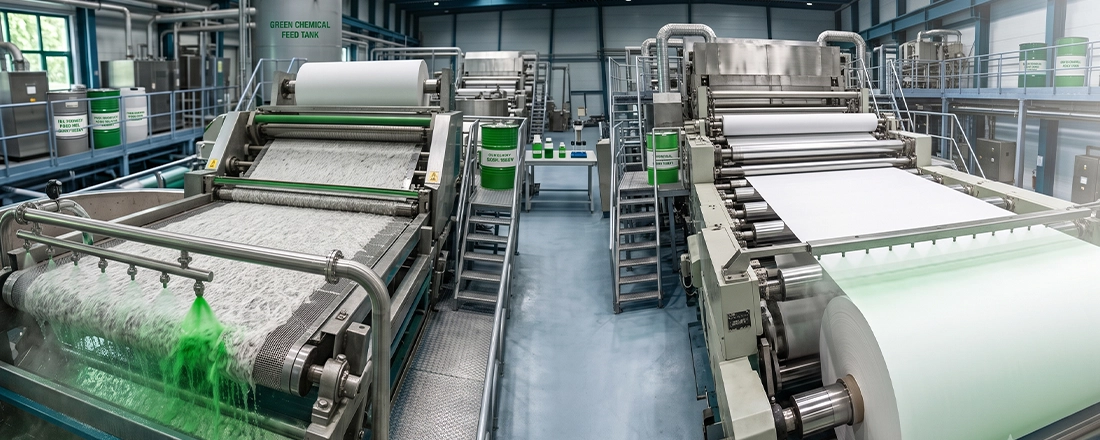
De-inking & Fibre Liberation
One of the most critical steps in recycled-paper production is de-inking — the process of removing inks, toners and adhesives so the fibres can be reused. Laboratory studies report that under optimal chemical and flotation conditions, yield rates of 88-94% can be achieved.
Using surfactants and specialized de-inking agents alters surface tension and promotes ink detachment from fibres, which is essential to producing high-quality recycled pulp.
Cleaning, Washing and Brightening
After the de-inking of the fibres, further treatment can be performed. Bleaching agents, which include chemical types like hydrogen peroxide, will give brightness and remove the remaining colour or lignin from the recycled pulp. The quality of the recovered fibre depends a lot on how clean and uniform it is. Chemistry plays a big role here.
Process Stability and Deposit Control
Recycling operations must manage more than just pulp or else fibre yield drops, contaminants build up, and machine downtime grows. They must control machine runnability. Drainage optimisation can be achieved with chemical aids for stickies suppression and microbial growth control.
Practical Steps: Using Chemicals to Improve Recyclability
- Match chemistry to furnish: The mix of source paper, inks and fillers varies widely. Ensuring that the surfactants, de-inking agents and process aids are tuned to that mix improves recovery yield.
- Optimise chemical dosage and conditions: A laboratory study reported a de-inking efficiency of 94% under optimal chemical conditions (enzymatic-magnetic de-inking technique).
- Prioritise fibre recovery: Returns in modern mills show fibre yield losses of 10-25% when chemistry and operations are sub-optimal.
- Integrate across chemistry fronts: Effective recycling uses a combination of de-inking agents, brightness boosters and process controls, not single standalone treatments.
Benefits You Can Measure
Using the right paper chemicals for recycling offers tangible benefits:
- Higher fibre yield: Better chemistry means more usable pulp and less waste.
- Improved fibre quality: cleaner and stronger recycled fibres mean higher performing end papers.
- Reduced operating cost: With minimal rejects and less downtime, smoother runs are possible.
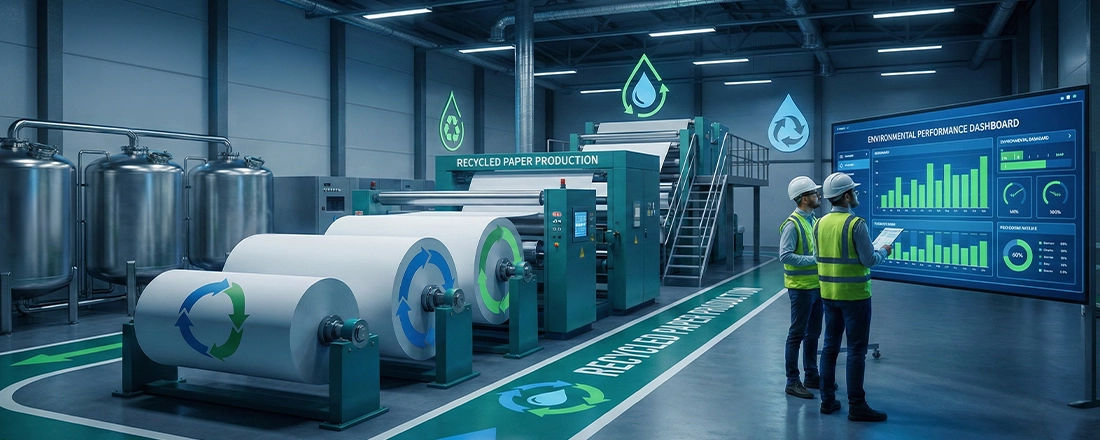
- Environmental benefits: Less use of virgin fibre, less water and energy consumption, and reduced landfill waste.
Challenges to Be Aware Of
The way ahead, however, is not smooth:
- There are various types of furnishes, coated papers, plastics, and adhesives, which make de-inking difficult and require more advanced chemical solutions.
- The cost benefit of high-performance chemicals must be considered carefully.
- Some wet-bonding or heavy resin chemistries may complicate later recycling. So, chemistry must consider the full lifecycle.
- Residual sludge from recycling steps still requires management, even when chemistry improves yield.
Conclusion
From collection to high-quality pulp, the transformation of waste paper into usable sheet material hinges on more than just mechanical steps. The right paper recycling chemicals enable mills to detach ink, protect fibres, optimise yields and reclaim value. If the question is how to make recycling truly perform, the answer lies in the formulation, integration and control of these chemical solutions.
For tailored solutions in paper recovery, yield optimisation and recycled performance, Ivax stands ready to support the next leap in sustainable papermaking.